Feeds:
Posts
Comments

Posts Tagged ‘Poetry’

My Ivy Farms Book Club dined on delicious crab soup, salad, and yummy bread. The scene through Virginia’s (yes, our host has the same name as our state) window was Arcadian, rolling pastures dotted with hay bales. Poetry was read aloud with alacrity; local poets, dead poets and poet laureates. And while driving home I realized I’d forgotten my sweater…

The name of the author is the first to go
followed obediently by the title, the plot,
the heartbreaking conclusion, the entire novel
which suddenly becomes one you have never read,
never even heard of,

as if, one by one, the memories you used to harbor
decided to retire to the southern hemisphere of the brain,
to a little fishing village where there are no phones.

Long ago you kissed the names of the nine Muses goodbye
and watched the quadratic equation pack its bag,
and even now as you memorize the order of the planets,

something else is slipping away, a state flower perhaps,
the address of an uncle, the capital of Paraguay.

Whatever it is you are struggling to remember,
it is not poised on the tip of your tongue,
not even lurking in some obscure corner of your spleen.

It has floated away down a dark mythological river
whose name begins with an L as far as you can recall,
well on your own way to oblivion where you will join those
who have even forgotten how to swim and how to ride a bicycle.

No wonder you rise in the middle of the night
to look up the date of a famous battle in a book on war.
No wonder the moon in the window seems to have drifted
out of a love poem that you used to know by heart.
Billy Collins

Of course I read Billy Collins, not the “Forgetfulness” poem, although someone else did, but one about Birds, and another about a House. I must have left my sweater where my spleen used to be. This was Virginia’s group email:

A lovely sweater was found on the back of a kitchen chair.

Does it belong to you?

If read properly, does this sound a little like Emily Dickinson?

This is how the poetry readings affected me.

I feel so sorry for Charles Wright.

But Billy, you were the Hero of the Night.

And so I replied:

At the last minute I threw it over my shoulder

Never knowing, always needing

To cover or contain my errant arms

Wide hips and sunkissed neck from light

To warm me in the chill of an air-conditoned night

To forget on the back of your chair

Late Summer Herbs

Late Summer Herbs

Read Full Post »

I am going to sit on a rock near some water

The Ivy Farms Book Club has asked its members to bring a poem to share at the next meeting. I chose to bring a poem by Billy Collins, our ex-Poet Laureate, who will be a keynote speaker at the KilKenny Arts Festival in Ireland this year. http://www.irishtimes.com/culture/books/billy-collins-when-i-start-a-poem-i-assume-the-indifference-of-readers-1.1891332?page=1

“When I start a poem, I assume the indifference of readers,” he says. “That there might even be a touch of hostility. There is a line from a Patrick Kavanagh poem that really resonates. It goes: ‘Tomorrow’s Wednesday. Who cares?’ Well, the reader can’t be expected to be interested in your life, the life of a stranger. The job of the poet is to seduce the reader, to make sure they are interested, to make something happen for them that is unexpected.”

When I write I rarely think about the reader, about cajoling her or him to like me or the content. I admit as a journalist I sometimes did, but today I write to make sense of things, I write to flex a muscle in my mind. I figure if the reader doesn’t like what I’m saying, he’ll stop reading! I hope this doesn’t seem cruel dear reader, but I’d rather not presume anything as I begin to write. That’s why I won’t check email or social media when I sit at my desk – later for that. I like to leave that morning space open for the muse of inspiration which will sometimes take hold of my fingers and take me in another direction.

Still I understand poetry may need a bit of a nudge. I like Mr Collins simply because he abhors obscurity or obfuscation in his verse. If he happens to be chopping parsley while listening or thinking about something else, it will find its way into his poem. And he is not writing for someone in an ivory tower, he feels the need to “seduce” us, the general public, with his words. And who doesn’t like to be seduced?

and I am going to stop talking

Last night Bob and I were laying out on the deck in total darkness, we were moon bathing. We wanted to see some shooting stars because it was time for the Perseid meteor shower. It was a perfectly clear night; we stopped talking and watched the enormity of the sky and its brilliant stars. On cue, stars began streaming from one spot in the solar system to another, in the constellation Leo, lying northeast of our ridgeline. I began to understand VanGogh. images

Then Bob said, “Do you hear that?” It was the sawing, symphonic sound of tree frogs chittering away at the edges of our star show. And the silence was broken as he told me more about his boyhood time at Four Bridges, and how much he loved that sound in the midsummer night.

I Love the sound of your voice

like a little saxophone

telling me what I could never know

unless I dug a hole all the way down

through the core of my self 

That was a verse in Collins’ poem “Orient. The other snippets are from “A Question About Birds.”                    Everyday Moments Caught in Time  

Sitting on a Bench to Watch Geese

Sitting on a Bench to Watch Geese


Read Full Post »

There was a time in my life in NJ, when I had to renew myself. Don’t get me wrong, I loved being a Mom, but ripping me out of the beautiful Berkshires, where my babies were born, left me adrift in suburbia. I didn’t fit in.

People in the North ask you, “Where did you move from?” People in the South ask you, “What church do you belong to?” Neither move had an acceptable answer, since I don’t go to church, and when I told my NJ acquaintances that we had lived in Pittsfield, MA, the resounding reaction was why the hell did I move to Central NJ?

For my husband’s job? To be closer to our family? Partially true.

Up until that point I’d been coasting along. Marry your high school sweetheart – check. Maybe not at the age of 30 after many years of Woodstock and Westchester, but hey, I was a late bloomer. I felt connected to the Berkshires, I started writing there and made friends that would last a lifetime. There was something about the New England character that spoke to me, something deep.

I kept a saying on my Jersey refrigerator, “Bloom where you’re planted,” and i tried to grow roots.

So I got a job writing at a weekly newspaper, I joined a beach club and ran for the school board. I started working on a Master’s Degree at Monmouth College (now “University”). I ran around trying to get my new suburban life started. And then one day my professor asked me to attend an educational symposium and my editor asked me to write about it too. Some dots were connecting.

That’s where I met and interviewed Ethan Hawke and Robert Sean Leonard. They were fresh off the buzz of Dead Poets Society and I wish I could link you to my article but we weren’t online in the early 90s. I do remember one thing that Hawke said to those teenagers, “Don’t wait around for your life to start, it’s happening right now.”

In light of Robin Williams’ death, I’ve been thinking about that movie. He played the English teacher we all wish we had in high school – and in fact, I did have Miss Flanagan who was phenomenal. I wish you had waited Robin, just a little, to see that your life still has so much meaning, that you brought such beauty and laughter to us all.

“Poetry beauty romance life, these are what we stay alive for…you may contribute a verse…the powerful play goes on and you may contribute a verse…”

“What will your verse be?”         https://www.youtube.com/watch?v=vq_XBP3NrBo


Read Full Post »

Unknown

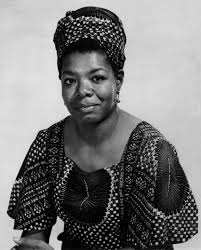
A phenomenal woman died this week. She was our spiritual mother, a national treasure; Maya Angelou had that voice that could peek into your soul and reach bedrock. She was what every poet must aspire to be, of every color and every gender and every nationality. She could transform words into pure emotion.

We Americans were lucky to have her around for 86 years, lucky to call her our own. She once said that courage was the most important virtue, and certainly to endure her early life of poverty and abuse she must have exhibited tremendous courage. I would add that patience is the least important. I’m pretty sure she would agree. “The capacity to accept or tolerate delay, trouble, or suffering without getting angry or upset,” according to the Oxford English Dictionary, is not an important virtue in my book.

It’s the second part of that definition that irks me. Because by squelching your feelings, even the angry ones, you nullify your existence. Every two year old knows that! OK, so I wouldn’t make a great yogi, suffering in silence, sorry. Feeling your anger is the first step to changing an untenable situation – ask any psychologist. Internalizing your anger equals high anxiety over a lifetime.

But for this weekend, when many of you are celebrating and not suffering, weddings and graduations, I thought I’d dig up an old commencement speech that Dr Angelou gave to the graduating class of 1977 at UC Riverside. She directs these young people to identify the heroes and sheroes in their lives, to be courageous and adventurous and NOT to travel a well worn path. RIP Maya Angelou, your words will live in our hearts forever.

Thank you very much. I’m delighted to be invited and certainly pleased by the reception. I thank the Chancellor, the officials, senior members and junior members of the institution, parents and friends.
In particular, I thank the graduating class. It seems to me that a commencement address always comes after the fact, after the long hours, after the tedious work, after trying to come to grips with somebody else’s ideas, after trying to stimulate one’s own brain so that it may come up with some ideas of its own. After all that, and even after the institution of higher education says to you, “You have done well, and to prove it I’m going to give you a diploma. After all that, then along comes a stranger who says, “I’m going to give you a commencement address.” It seems a contradiction, or else a little presumptuous. However, (pauses for laughter) there is a challenge that faces you that is incredible. And the challenge is not new. However it has not abated. The challenge is how to create a sense of adventure toward life and how to maintain that sense of adventure. There is an African statement that says, “The trouble for the thief is not how to steal the bugle, but where to blow it.” And it would seem that the trouble for you is not just how to get out of this institution, but once out, what does one do? Does one simply sit with that diploma and say, “I have found the one way, the true way for myself and I call all the others false.” Or do you indeed join life, that is the challenge.
There’s a poem that says. “She does not know her beauty. She thinks her brown body has no glory. If she could dance naked under palm trees and see her image in the river, she would know.” But there are no palm trees on the street and dishwater gives back no images. Now, the way one maintains, I believe, a sense of adventure, a love of life, and since life loves the liver of it, or certainly seems to favor the adventurous spirit, it is a wonderful thing to maintain that idea, that concept. The one way is to keep alive heroes and sheroes. I believe that people live in direct relationship with the heroes and sheroes they honor. And I will talk to you about sheroes and heroes. I don’t believe that he or she must always be embodied in the physical body. I believe that an idea can be a shero or hero. Certainly the idea of religion can be.
Black Americans were first brought to this country in 1619. That was one year before the Mayflower docked. That’s an aside (laughter.) Today, we are upwards of thirty million and that’s a conservative estimate. How do people continue to exist, and walk as if they have oil wells in their back yards, except that there is a hero/shero that stays alive. Some years ago when I was with “Porgy and Bess,” we went to Morocco. The company had traveled through many countries. And when we arrived in Morocco, we were told that the sets had been sent on to Spain, and we were obliged to give a concert. Well opera singers, as some of you know because some of your are, are a people always prepared to sing. I believe they have their portfolios taped behind their watches or something, they are always ready. So when the conductor said to the singers, “We should do a concert,” they really got into fine voice. I was the premiere danseuse and I simply couldn’t. I was not trained in that discipline. I went to the conductor and I said, “I’m sorry, I’m not able to sing. I don’t have any arias. He turned to me, he was Russian, and said, “Bah. Don’t you know a spiritual?”
I grew up in a small town in Arkansas, about the size of this side of the seating (she gestures to one side of the audience.) We went to church on Sunday. I don’t mean we went to church and left. We went to church on Sunday, that was all day, and then Monday night missionary meeting, Tuesday night deacon meeting, Wednesday night prayer meeting, and so on. And at all these meetings we sang. Now I had never really thought about the black American spiritual. I never understood what meaning, what value it had, until that night in Morocco. The people in the company went out and delivered themselves of these beautiful arias, from Rossini and Resphigi and Handel and Purcell, just lovely things, Mozart. And they were well received. But then I went out onto the stage and there was a pit with a 120-piece orchestra. But how could they help me with their violins, celli and things. So I said, “It’s alright.” And I sang a song that my grandmother sang every Sunday of my life until I was 13 and left that small town in Arkansas. When I finished, 4,000 people stood up and stomped and made noise and shouted. (here she imitates some of the language.) And I thought, uh huh. What was that? It wasn’t for my singing. I can sing fairly well. But it wasn’t that. I walked away from the auditorium and I walked alone in Morocco trying to come to grips with what had happened. The great singers had sung “La Donna’ e Mobile,” (she sings it) and sung it beautifully. They had done it to perfection, lyrically. And I sang, what I had thought to be a good song, but not very important music. And there were 4,000 people screaming my name. And then I realized that my people could not give me the great names that bring shivers in the marketplaces. They couldn’t give me the land that people barter their souls for sometimes, nor money, nor power. But what they gave me was a hero/shero that allowed me to walk as tall, and be free enough to accept other ideas, ideas other than those that generate within my own community. And it is that for which I am very grateful. It is that I want to encourage in the breasts and minds of the graduating class.
There is among black Americans, for centuries, we were known to laugh when we weren’t tickled, and scratch when we didn’t itch. And those gestures have come down to us as “Uncle Tomming.” I suggest to you that those people, who were successful in that particular strategy, are heroes and sheroes, and we live in direct relation to the heroes and sheroes that we have. I wrote a poem for a woman who is a maid in New York City. She rides the bus. When the bus stops too fast, she goes “Ah ha ha ha ha ha.” When it picks someone up, she goes, “Ah ha ha ha ha ha.” When it misses them, she goes, “Ah ha ha ha ha ha.” And I thought, “Now what is that?” Really? If you don’t know black features you may think she is smiling. She’s not smiling at all. She’s exercising that old survival apparatus, that’s all. So I wrote a poem for her, because she is a shero of mine.
When I think about myself, I almost laugh myself to death.
My life has been one great big joke, a dance what’s walked, a song what’s spoke.
I laugh so hard I nearly choke, when I think about myself.
Sixty years in these folks’ world, the child I works for calls me “girl.”
And I say “yes, ma’am” for workin’s sake. I’m too proud to bend and too poor to break.
So hmph, humph, ha, ha, humph, I laugh until my stomach ache, when I think about myself.
My folks can make me split my side. I laugh so hard I nearly died.
The tales they tell sound just like lyin’. They grow the fruit, but eat the rind.
I laugh so hard, I start to cryin’ when I think about myself.
Ladies and gentlemen, a good commencement address should be brief. It might be funny. In this case I shall not be funny. I will encourage you along the lines of Terence, a playwright in 150 B.C., who said, “I am a human being. Nothing human can be alien to me.” It is interesting that his name is Terentius Afer, or Terence of Africa. He was a slave sold to a Roman Senator, freed by that Senator, and he became the most popular playwright in Rome. And he said, “I am a human being. Nothing human can be alien to me.”
I encourage you to live with life. Be courageous, adventurous. Give us a tomorrow, more than we deserve. I thank you very much, and I encourage you to commence.

http://newsroom.ucr.edu/announcements/2009-10-24maya-angelou.html

Read Full Post »

I recently discovered a website called “Letters of Note.” http://www.lettersofnote.com Whoever thought of digging up old letters from famous, and not so famous, writers was genius. It all started with an obit that EB White wrote for his dog Daisy, who happened to be sniffing the flowers in front of a shop when a carriage careened into her. Most of us know White because of his spider named Charlotte; he is masterful at writing for children. I always thought that a good children’s writer had to have never really left childhood behind. There had to be a Peter Pan quality to him when he wrote about Daisy; that she was born, “an unqualified surprise to her mother.”

My Cardigan Welsh Corgi, Tootsie Roll, was extremely surprised when she delivered her brood in the corner of the living room, on the good rug, and NOT in the whelping box I had so carefully arranged in the family room. And as most doggie people know, each and every one of her puppies had a personality all its own. One was sweet and cuddly, one was aggressive and always first to dine. One loved to explore and one was always hiding. Blaze, the one we kept, was the alpha male. He seemed to know he was in charge of his siblings from the moment he opened his eyes. I was writing for the newspaper back then, but now how I wish I’d put pen to paper about the pups.

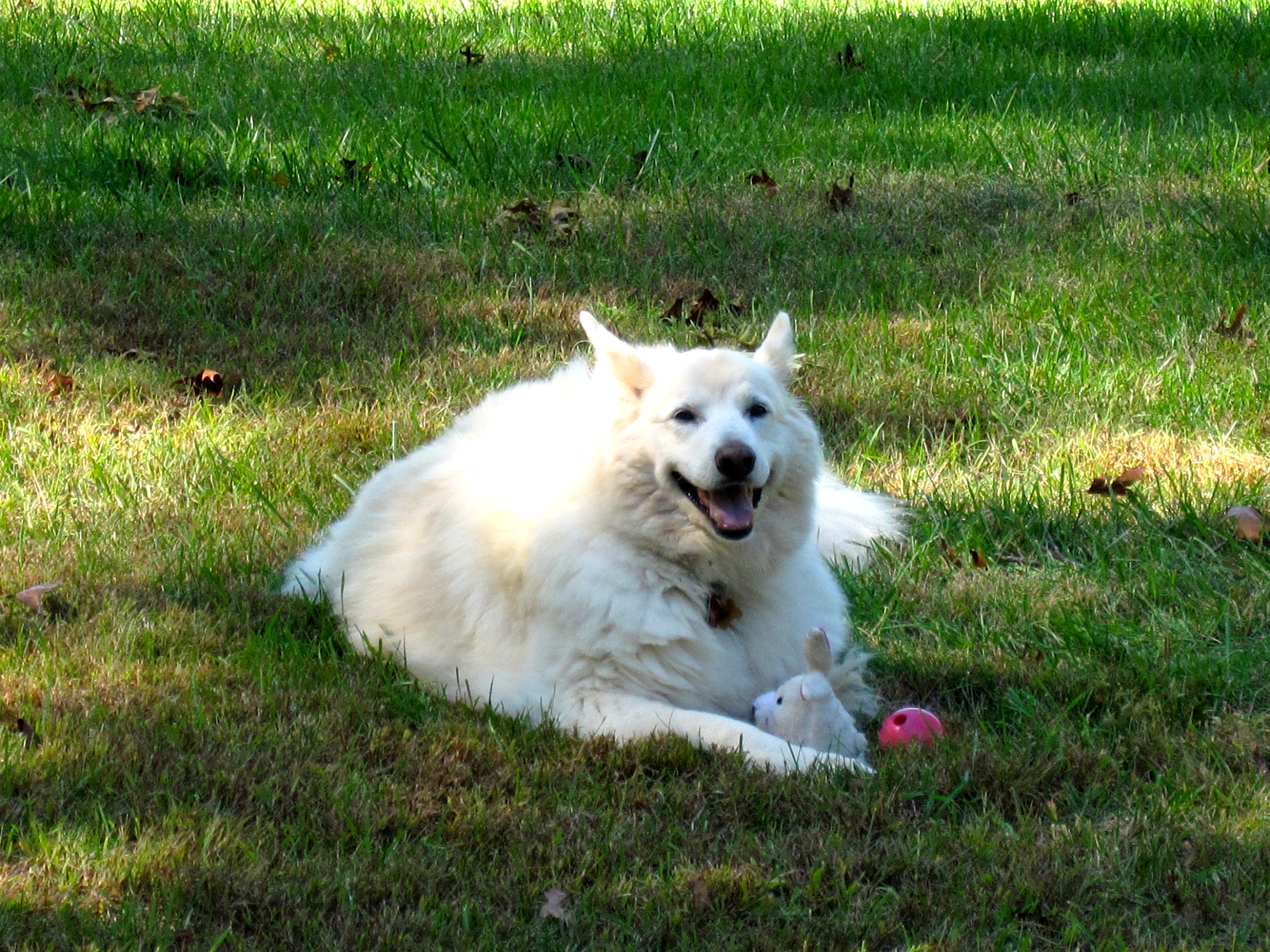
I am thinking of writing some small poems about our dog Buddha for the Love Bug. I’ve already asked my artistic sister Kay to illustrate a story or two. Buddha came from the SPCA at the Jersey Shore and looked a little like a polar bear – he was a hundred pounds of white fluffy Samoyed-mixed love! So tell me what you think of my first attempt at a beginning?

Buddha Springs into Action

Buddha awoke and stretched himself

Gently into downward dog

Looking up, he thanked the tree

Shimmering in the morning fog

The tree was full of birds

Singing sweetly, flapping wings

Dancing in her branches

A Blue Heron was the King

“Good Morning Buddha Bear,” he said

“Happy day to one and all”

The big white dog sat down at once

To hear the sea wind call

Buddha Bear in the Blue Ridge

Buddha Bear in the Blue Ridge

Read Full Post »

Christmas used to be tough for me. Once the kids left home, Bob continued to work on Christmas Eve and Christmas, and I was left to my druthers. Sometimes, a newly divorced friend might join me at the movies, but most times I was on my own to ponder the meaning of the universe. Now that the Bride has followed in her dad’s footsteps, she finds herself working on Christmas too. And lucky for me, I get to hang out with the Love Bug in Nashville, my own personal little Christmas elf.IMG_2317

Yesterday, she took me to the most amazing puppet show at the Nashville Public Library. http://www.nashvillescene.com/nashville/john-updikes-a-childs-calendar-at-the-library/Content?oid=1203840

Updike’s A Child’s Calendar is an illustrated collection of twelve poems describing a child’s life as the weather changes and the year goes by. This staging is the brainchild of Brian Hull, the Nashville Library’s director of children’s programming, who transforms Updike’s collection into a musical show populated entirely by child-sized puppets. Hull’s puppet fixation is part of a Nashville tradition dating back to 1938, when longtime library associate Tom Tichenor first began holding marionette shows at the main branch.

The puppeteers are dressed entirely in black while they manipulate an old man puppet and a young boy going through each magical month around a growing tree on stage. Birds fly overhead, and blossoms rain down from the sky. At one point a real boy tried crawling up on stage to catch a blossom, and the puppet motioned him away! The Love Bug danced and watched every move with wonder, her eyes open wide. I wanted to cry, with joy. Because this is one of those things we’ve forgotten as adults. The sheer delight of everyday life as seen through a child’s eyes. Here is what Updike had to say about January:

The river is
A frozen place
Held still beneath
The trees’ black lace.

The sky is low.
The wind is gray.
The radiator
Purrs all day.

Christmas holds hidden delights for everyone with children of a certain age. Some are watching a little elf who appears on a shelf every morning. He helps Santa keep track of every single child, naughty and nice. Some are going to see the Nutcracker for the very first time. And some are attending puppet shows and cuddling with their Nana. Instead of sugar plum fairies, grandparents galore are coming to visit!

Have a very Merry Christmas everyone! And tornado warnings or not, don’t forget that family comes first…and after that an egg nog latte helps. Cheers.

Read Full Post »

Every single place you go there is an opportunity to learn something new. Last night, we were picking up some comfort Mexican food at our newest neighborhood restaurant, when we overheard this guy waiting for his to-go order say that the deer would be starving this winter. He wasn’t exactly a mountain man, but he did look like he knew a thing or two about hunting. So I interrupted his conversation about how many deer had been spotted and/or hit by a car on his way over here, a common subject in this neck of the woods, to ask him why the deer would starve this winter. I was expecting to hear about another snowmageddon.

Instead, he told us that their main food source, acorns, had been decimated by those tasty little critters Ms Bean loved to crunch. IMG_0595In this year of the cicada – where numbers reached one million per acre and sometimes more – not only did the insects hatch their eggs in the branches of oak trees, they managed to feed on and kill off those portions of the tree. I had noticed splotches of dead, brown leaves at the ends of many of our oaks, and I knew the cicadas were responsible. Even though this was the 17 year plague of the cacophonous insect, I was told our trees would survive the onslaught. I didn’t think about the loss of acorns.

Don’t look away Ms Bean, you know you loved them!

 An acorn on an oak tree grew,
The wind around him gently blew,
It whispered to him quite softly
‘Some day from your mother
You will be free
To grow and be a mighty tree’
‘Who’? ‘Me’? A mighty oak’?
The little acorn thought this a joke.

Acorns have been the subject of poetry, like the above poem by Joseph Enright, and have been used in heraldry designs for centuries. In fact, I believe they gave bonny Prince George’s mum, Kate, a crest with an acorn when she married into the Royal Family. Here it is on the right, joined with Prince Wills. There are three acorn sprigs that represent the three children in the Middleton family. And the leaves represent Berkshire, where she grew up.  I like the unicorn!article-2434825-1850314F00000578-643_634x505

Yesterday morning I looked out my kitchen window to see a mama deer with two young fawns nursing underneath her. She stood straight and tall and we just stared at each other. We’ve posted our property so that hunters are forbidden, still I don’t want these beautiful animals to starve. This weekend I’ll be going to a farm supply store, to see what deer would like to eat. They’ve finished off my roses, and the new growth of a few tender shrubs. One even managed to find and trample the fence around a new fig tree, but he only ate half of it. Considerate don’t you think?

Kensington Palace released this photo of the new conjugal coat of arms for the Duke and Duchess of Cambridge

Read more: http://www.dailymail.co.uk/femail/article-2434825/Kate-Middleton-Prince-Williams-new-Conjungal-Coat-Arms-revealed.html#ixzz2iqKSH400
Follow us: @MailOnline on Twitter | DailyMail on Facebook

Read Full Post »

Who can resist a Snickers shaped like a pumpkin masquerading as a Reese’s peanut butter cup?

It’s funny really, I’ve never had a sweet tooth. Never stored bars of candy in a drawer in the kitchen. Maybe that’s why Halloween was so sacred to my kids, and they milked it for as many years as they could. They knew which houses had the full-size candy bars and which gave out bags of raisins. 

The first time I said “No” to my baby Bride was in a check-out line at the grocery store. I was trying to be all “natural mom” back in the 80s. with real diapers and pureeing my own baby food in a Mouli grater. We even joined a food co-op from Vermont! I didn’t think I’d ever have to say the word “No” about anything, after all couldn’t distraction and/or avoidance solve most discipline problems? Turns out, there’s no avoiding that stack of candy within arm’s reach of a toddler determined to get her hands on some gummy bears.

Now put a bag of chips in front of me, and it’s a different story. I’m just a pushover for salt.

Which is fine, since it turns out that Americans ingest about 138 pounds of sugar a year, and that only serves to increase our risk of heart disease. Because a new study in the British Medical Journal suggests that sugar could be worse for us than fat – raising our cholesterol etc. It’s certainly always been good news for dentists,  Sorry Eric. Now we know something I’ve always known intuitively – grass-fed Irish cow butter is better for us than cookies! There, I said it. http://www.independent.co.uk/life-style/health-and-families/health-news/top-heart-doctor-unprocessed-fatty-foods-may-actually-be-good-for-you-8897707.html

Don’t get me wrong. I’d much rather put a little real sugar in my coffee than an artificial sweetener. Sticking with real food can never lead us down that scary grocery aisle with processed homogenized cheese spread. I recently modernized the Flapper’s version of Depression mac and cheese when my Bug was visiting.

Mac and cheese please

Mac and cheese please

Since butter was scarce in the 30s, my Mom used bacon to start her scrumptious recipe and inserted slices of Swiss cheese from the deli. I found some Gruyere and shredded it instead. I can still remember her saying that she made this mac and cheese for my brother Michael, because it was his favorite dish. It turned out he was her favorite child.

And no matter how many times I said it was my favorite dish too, it didn’t matter. So when you watch this video poetry slam by Lily Myers about “The Shrinking Woman,”  “I have been taught accommodation, I have been taught to grow in…to create space around myself.” Think about how we too are entitled to calories, about how we women are worthy of filling that space. And pass the bread and butter please. 

You may have to click over to the wordpress site to watch the video, but believe me, it’s worth it.


Read Full Post »

Yesterday afternoon, a little boy was visiting so I turned on the TV to find the Disney Channel. Up pops CNN with a rugged, red-faced swimmer leaning on the arms of others, and everyone in my living room was instantly transfixed, even the three year old. We leaned in to hear her words, and in the middle of her second message (or “rules for life” let’s call it) our satellite went out. Maybe I didn’t hear her words in real time, but Diana Nyad spoke to me online with her three rules. I figured if a woman my age could swim from Cuba to Key West, I could listen to her.

I have three messages. One is, we should never, ever give up. Two is, you’re never too old to chase your dream. Three is, it looks like a solitary sport, but it is a team.

This woman swam for 53 hours, without a shark cage and with only a silicone mask for her face at night to protect her from jelly fish. But what really got me, even beyond the fact that this was her FIFTH try to swim 110 miles, was that her strokes-per-minute never varied, she was a slow and steady 50 strokes per minute!

We’ve all heard of inspiration boards on Pinterest, and inspirational speakers who like to talk about their time as dare-devil Navy pilots landing on aircraft carriers at sea with only a 500′ runway. Yes, I sat through that one. But an inspirational swimmer, now that’s something!

http://www.huffingtonpost.com/2013/09/02/diana-nyad-swim-cuba-florida-complete_n_3856821.html

I just read about a woman who has a picture of Joan of Arc in her bedroom, she figures if Joan could change the course of history before the age of 18, she should be able to get out of bed.

I’m hanging a picture of Diana Nyad on my study wall. So what if I torqued my spine in water aerobics, so what if my yoga studio closed its doors, so what if my knee sounds like crepe paper. No more excuses! After all, if Nyad could swim from Cuba to Florida, I can…what? Dance again, maybe like the Flapper did after our Year of Living Dangerously. One beautiful stroke at a time.

Perseverance is a critical quality. Like the Love Bug crawling every day to the dog’s water bowl even though she finds the door to the mud room closed most of the time. She gets out of her giraffe chair, puts on her goggles and dashes across that kitchen floor in the blink of an eye. IMG_1786Still, she crawls. I think of Maya Angelou’s inspiring words:

“Just like moons and like suns,
With the certainty of tides,
Just like hopes springing high,
Still I’ll rise.”

Diana Nyad

Read Full Post »

On my long drive home this past weekend, I listened on and off, between mountain ranges shrouded in fog, to an interview on NPR with New York’s Poet Laureate, Marie Howe. It turns out April is Poetry month and this was a repeat of Terry Gross’ Fresh Air program from last year. Somehow I knew she was a kindred spirit. Howe grew up in a large Irish Catholic family, and attended the Convent of the Sacred of the Heart. As my BFF Lee from the Berkshires likes to say, we went to different schools together.

“Poetry holds the knowledge that we are alive and that we know we’re going to die,” says Howe. “The most mysterious aspect of being alive might be that — and poetry knows that.”

Howe has written 3 books of poetry: What the Living Do, The Kingdom of Ordinary Time and The Good Thief. She talked about teaching poetry, about describing the way water looks in a glass that has filtered sunlight streaming through it. About getting her students to bring their focus into the world of everyday things without using metaphor. Saving metaphor for much later, like a gift left under the Christmas tree. Yes, I realize I didn’t wait.

Howe’s father was an alcoholic, which she states as if this is the most common thing for a family, which of course it is. How many fathers in the 50s functioned fine enough by day, only to return home to drink and brutalize their family? There is, “A sense of retroactive dread…so many of us are afflicted with addictions,” she says. One of her brothers, Johnny, died of AIDs in the late 80s, and she memorialized him with this poem:
What the Living Do

Johnny, the kitchen sink has been clogged for days, some utensil probably fell down there.
And the Drano won’t work but smells dangerous, and the crusty dishes have piled up

waiting for the plumber I still haven’t called. This is the everyday we spoke of.
It’s winter again: the sky’s a deep, headstrong blue, and the sunlight pours through

the open living-room windows because the heat’s on too high in here and I can’t turn it off.
For weeks now, driving, or dropping a bag of groceries in the street, the bag breaking,

I’ve been thinking: This is what the living do.

Johnny, who ran away from his father but found his own demons, finally found AA and used to tell her that, “Pain is inevitable, but suffering is a choice.” She loved him dearly and said sometimes he would just stand in the middle of her kitchen and say, “This is it.” And she would say, “What?” He would just raise his arms, look around with a smile, and say, “This.” I was reminded of my brother Michael, who died last year. Every time I would see him, he would smile and tell me, “This is the good life.”

The Flapper would read poems aloud to my brothers and sisters from an old anthology, “101 Famous Poems.” First written in 1929, I remember its well worn blue binding, and managed to find a revised edition from 1958. Shirley, Brian, Kay, Michael, and Jimmy heard about the sea, and a cautionary tale about a spider and a fly while doing household chores. Poetry was the music that accompanied everyday life while the Flapper could only sit and read, her legs broken in so many places. As Marie Howe said, art allows the heart to break open.
http://www.npr.org/2012/04/13/150495862/poet-marie-howe-reflects-on-the-living-after-loss
images

Read Full Post »

« Newer Posts - Older Posts »