Feeds:
Posts
Comments

Picasso

While my daughter the Bride was exploring Seattle, and my son the Rocker was debuting his band’s sophomore album in Brooklyn, Bob and I decided not to sit around on our laurels, so we traveled to Richmond to see Picasso at the Virginia Museum of Fine Arts (VMFA). I knew I wasn’t a Northerner anymore because while strolling through this crowded museum space, people would apologize for either bumping into me, or crossing in front of me. I almost clicked my heels over the sheer civility of it all!

Born in Spain in 1881, Pablo Picasso made Paris his home at the age of 22. The sheer volume of this exhibit in Richmond is extraordinary, but only a small example of the 50,000 works he produced over his lifetime – all done in different mediums. As the museum’s literature so succinctly put it: “Picasso … remained open to all kinds of stimulation and restlessly moved on to new forms (and women I might add) before depleting any one style of expression.” He and his room mate, Braques, developed a different way of interpreting their world, they called it Cubism.

By the age of 12 Picasso was a better painter than his own father, and could paint in the representational style of Dutch masters. But as he said when he painted his son in a jester’s costume, his paintings had to leave space, things unfinished, because that was his art. Soon afterward, he was deconstructing and fracturing the human form in ways almost unrecognizable. His paintings and sculpture not only represent his own inner world, they reflect the tumultuous times, the wars, and a movement – the “modern” aesthetic that sustained him.

Touring the exhibit was a most holy ritual. Seeing up close and personal his style of plastering paint on canvas and then hatching it off, the sequential photos of him preparing his masterpiece of war, Guernica, and the brilliant  portraits of his wives and mistresses, left me breathless. I came away realizing genius and madness are closer than we think. His advice while living in the South of France after WWII was to, “Only put off until tomorrow what you are willing to die having left undone.”

Waiting in Line

We always encouraged our children to follow their passion, which explains the scientist and the artist traveling around the country. Music coursed through our son’s veins, he could never deny that muse. And I wish him and the Parlor Mob an amazingly  successful second album and world-wide tour! Here is a picture of the Rocker a couple of years ago in Paris. I would love to see how Picasso would paint those long red legs!

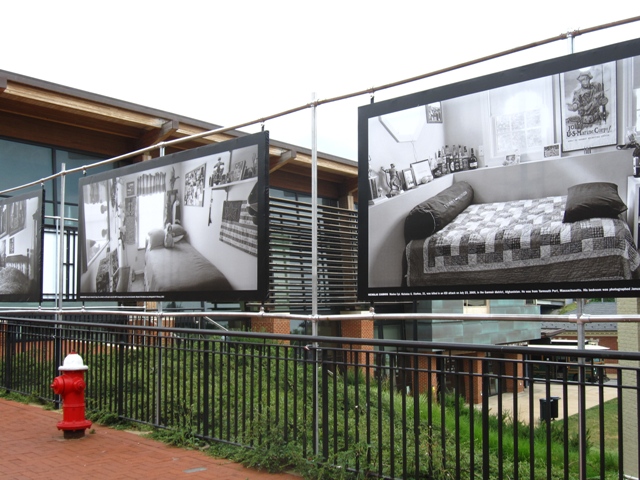
Photography was prohibited inside VMFA (included is a  shot standing in the line). But here is a website that lets you create an artistic portrait, not in Picasso’s style unfortunately, with a photo.  I wish you a life as long and vitally creative as Pablo, and fun playing with computer imagery. This is what becomes of my face, when treated to a Modigliani interpretation! What makes me think he may have had astigmatism?

http://morph.cs.st-andrews.ac.uk/Transformer/index.html

Tim and Anita

What a day. Not everyone can say that one of their best friends also happens to be a relative – and a very savvy, politico too. We had just sat down to lunch on the Mall when my cousin Anita’s eyes lit up and she said, “There’s our Governor.” He leaned in, shook my hand, and said, “Hi, I’m Tim!” Needless to say, we had a nice chat and told Tim Kaine we were happy he wanted to fill Senator Webb’s boots next year.

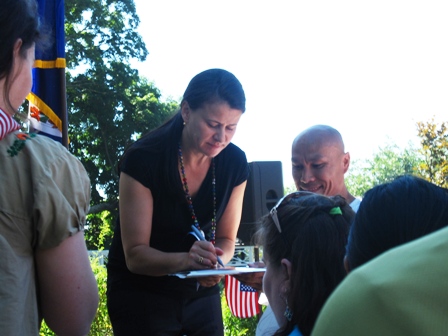
After lunch, we hopped over to the Jefferson Library for a book launch. Next door to Monticello, it is the repository of everything about our Third President. A gorgeous piece of architecture that was built in 2002, you feel celestial, embraced by the bookshelves in its main hall. Author and current Professor of “Imperial British History” at Harvard, Maya Jasanoff introduced the standing-room-only crowd to her new book, Liberty’s Exiles, American Loyalists in the Revolutionary World. Called an intimate narrative history, this is non-fiction you can sink your teeth into.

Maya signing books

I learned that on November, 25, 1783 our country was actually liberated. That was the date that General George Washington rode into New York City and proclaimed the British Occupation to be over. 60,000 Loyalists fled taking with them some 15,000 Black slaves. Less than 15% went to Great Britain, with about half going north to Eastern Canada, and the rest scattered throughout the Caribbean and West Africa and even India. Here is history from a different point of view, freedom was promised to those slaves who would follow. But as Ms Jasanoff said, “Lives that are once unsettled, cannot be easily put to right again.” This is a must read, about migration and tolerance; looking at freedom through the Loyalist lens. And Mr. Jefferson was hardly mentioned at all.

As most of you already know, I started this here blogging thing to help me make sense of my daughter, the Bride’s wedding. Like any good writer, I kept at it long after the last bill was paid. Managing not to even mention a certain Royal Wedding that just took place across the pond, while tornadoes and now floods here at home became footnotes to the Royal Couple’s honeymoon plans. Well, this morning I awoke to the news that the Governor and First Lady of California are separating. Maria Shriver, niece of JFK, is a part of the family we Americans call home-grown royalty…and now she’s joining the ranks of the Baby Boomer’s final hurrah – the Grey Divorce (pronounced ‘dee-vor-say’).

The single largest age group with increasing divorce statistics, Boomers ranging in age from 45 to 65, have never done things the conventional way. After all, we participated in Love-Ins, pushed for the Pill, and dared to institute the “No-Fault” divorce, aka irreconcilable differences. Before us, women had to prove their man was a philanderer or a wife-beater to break free. Now, marriage is on the decline and grey divorce is on the incline, what’s happening here?

My first clue about this trend was the Tipper and Al Gore break-up. People married for 30 plus years are calling it quits for a variety of different reasons: women’s financial independence; we’re living longer and were never meant to be monogamous, like geese; and wait for it, one day after the kids leave home, we turn to each other and ask the age old question, “Who are you?” My in-Laws have been married for thirty years, the Bride was their Flower Girl. They found love later in life; the widower (H) found A after a messy divorce. A is still a marriage and family counselor, at age 87; and H is a woodcarver, a WWII veteran who used to be a Baptist missionary and pastoral counselor. Here he is at the Bride’s wedding rehearsal.

H - Grandpa and Officiant

I don’t need to ask them what they’re doing tonight. They’ll be meeting their friends for pot pie at a diner, cause that’s what they do on Tuesdays. Growing old gracefully takes tending, just like friends or a garden or a marriage.

The Flapper

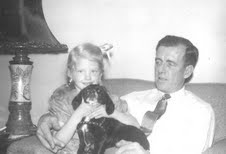
Born in 1908, Gertrude Smith was a flapper. Barely 5’2” tall, her blonde hair was neatly combed into a Marcel wave ending just below her ear. She told me once or twice, that when she was young she was a “rebel.” Her ancestors were Irish coal-miners, who settled in Scranton, PA. She was widowed three times. I was her last child, and these are some of the things she taught me.

“Signs are for sheep.” My Mother could always find her way in, around, over  or under a problem. She encouraged us to think for ourselves, never to take “No” for an answer, and to always hit back harder when faced with a bully. She did not suffer fools at all. When Nell and my Mother first met as teens, she was sporting a black eye. When asked how she got it, Nell said, “Your Mother could swear like a sailor.”

“I’ll not only walk again, I’ll dance.” After losing her husband to a brain  tumor, and surviving the car accident that sent me to live with Nell, this is what she had to say to her doctors. The engine of the car had crushed her beautiful dancer’s legs. The legs that had won many a late night contest with the Jimmy Dorsey Orchestra. There would be no wheelchair in her future.

“Fine, all the more for the rest of us.” This was said whenever I refused to eat something. Mother believed in reverse psychology; this was her parental mantra. Surprisingly, it worked. Watching my brothers and sister chow down with glee always made me rethink my decision. Nell made me finish everything on my plate, which I hated. With apparent indifference, Mother gave me permission to control my own life; and maybe saved me from an eating disorder?

“You are in your perfect place.” A big believer in Norman Vincent Peale and the Power of Positive Thinking (this came in her later, post-Freudian years), Mother would hang a picture of something she wanted on the refrigerator.  Inevitably, she’d get it. She talked about the science of the mind and eventually became a big muckity muck in the Unity church. I knew she hated most organized religions, so this was puzzling to me. But in the end, I believe the combination of spirituality and psychiatry brought her a certain peace.

“When they’re in here, I’m their Mother. When they’re outside , they’re in God’s hands.” Having six children may foster this type of thinking – it is the antithesis of helicopter parenting, necessary for survival mode parenting. Once as young wives, Nell was having coffee in the dining room with Mother and saw my older brother Mike teetering on the porch rail, over a 30′ drop to the back yard. This was her reply, looking serenely at Mike out the bay window, to my nearly panicked foster mother. You might say I benefited from the Yin and the Yang of motherhood.

Happy Mother's Day, I still miss you.

Met our Bride’s Chef Mark of L’Etoile for mint pea soup; found Marie’s best biscuits; and filled a tray with Mother’s Day flowers for my planters. Life is Good!

Collen Davis came to town today. It just so happens that Mimi Hyde, the owner of our local yarn shop, The Needle Lady, spotted Colleen at a conference in Atlanta last month. She recognized her by her sweater, of course. And since the famous free-style designer from San Diego would be visiting her daughter in Richmond over Mother’s Day weekend, well, one thing led to another. Here is Mimi modeling a Colleen Davis original.

Colleen told us that it all starts with color for her, “…color, color, color!” Although she’d been knitting since she was a girl, she started playing with yarn in a creative way after taking a class in 1996 on a Japanese style of dressmaking. Wanting to use up her stash of odds and ends and “…try something new,” she thought she could knit in a modular way, with color as her muse.  I was enthralled, really no patterns? Her inspiration might come from nature, or a building, or a layout in a magazine. Baskets of yarn are organized by color in her studio helping to create the free-form, butterfly effects of her beautiful sweaters.

Some of Colleen’s designs look like stained glass, and others look like a babbling stream. It’s as if someone just opened up a box of fingerpaints and said, “Go at it, have fun!” She told us that free-form knitting cannot be written down; and that “…gauge is a naughty word.” I felt my inner creative child was about to be given a permission slip! What a treasure. Here is her website:  http://www.toboldlyknit.com/ And here is Nicky, the mascot of the best little yarn shop in Virginia; thanks Mimi!

Thought you may want to see my first attempt, last year, at knitting a cable (also a first) scarf from the heavenly alpaca wool of my friend, Rivanna River Farmer, and neighbor, DeeDee!

The dwarf Korean lilacs are in bloom outside my sleeping porch. They perfume the air as we clean the gutters, slip into the hot tub, or take a break to read under the twirling ceiling fan. Although I directed the builders at the very last minute to attach a porch off the master bedroom, we don’t actually sleep there, like true Southerners might have done in pre-AC days. But we do rest there, on our zero-gravity chairs, and smell the lilacs.

Lilacs bloomed outside my bedroom window when I was a girl, my foster mother Nell would mound them in mason jars on the kitchen table. She had a beautiful smile, and the best sense of humor. At some point in my young life, I decided it was my mission to make her laugh. Her husband Jim, made me doll houses out of Popsicle sticks, and together they created a home. A home full of love and laughter. And although Nell didn’t drive, because in those days women rarely did, I felt as if anything was possible.

I planted lilacs outside our home in NJ, in Nell’s honor. Every morning, a Great Blue Heron would swoop out over them toward the river to fish for breakfast. And I brought pressed lilacs to the 9/11 widow two houses away who’s husband, Michael Patrick Tucker, worked at Cantor Fitzgerald. Our little borough lost 13 people on that day. As I stood at the memorial weeks later, I remember thinking, “How can I put this into words?” There were no words.

Which is why I enjoyed reading this article at NPR’s website, about the ambivalence of hearing about the death of the BinLaden. “…because terrorism partakes of both crime and war, it is perfectly natural, and perhaps legitimate, to have both of these attitudes towards Osama bin Laden: to think that we had to disable him, and to think that he deserved to die.”

http://www.npr.org/2011/05/03/135927693/is-it-wrong-to-celebrate-bin-ladens-death?sc=fb&cc=fp

If a Harvard professor of Philosophy thinks it’s perfectly legitimate to rejoice in someone’s death while still thinking he was a sorry old man, probably sick in so many different ways; and that each person’s death diminishes me, to semi-quote John Donne, leaves me feeling hopeful. And thinking I may have to take a philosophy book out on my porch, and shut off the news of the day.

So this is what happens when I go to a blogging symposium and actually listen to the speakers. I start a New Blog! Big thanks to Denise Stewart for her fun and outstanding opening and to Marijean Jaggers who has almost convinced me to start Twittering, almost.

I’m reading a new book at the recommendation of my BFF from MA, Lee. The Zen of Listening ‘Mindful Communication in the Age of Distraction’ by Rebecca Shafir is a smart and important read. She advises us to forget about our own personal self-interests and past insults, and step into the story, or “movie,” of the speaker’s life. She quotes Gandhi, “Three fourths of the miseries and misunderstandings of the world will disappear if we step in the shoes of our adversaries and understand their viewpoint.” Think about it, how often are you talking with someone only to notice their attention drift off – to their buzzing phone or the next person coming in the door – and wonder if it’s them or something you said, or maybe didn’t say fast enough?

Last week, I attended a hospital-sponsored lecture on patient safety. The speaker, Sorrel, is the mother of an 18 month old girl named Josie King who was admitted to Hopkins in 2001. The baby was treated for burns and moved from the PICU to a step-down unit and within 24 hours of being released when she suddenly died. Well, actually Sorrel had told two nurses that last day she thought Josie “…looked strange.” And she was dismissed by these nurses and told “…not to worry,” her vitals were just fine and to give her ice chips. Then when one doctor canceled an order for a drug, another walked in to give Josie the shot.

98,000 people die every year due to medical errors, and the one common thread that runs through their stories is, “They didn’t listen.” I was moved by Sorrel King and her foundation: http://www.josieking.org/

I asked my friend Lee, what do you do with someone who never stops talking long enough to listen? She said, “That’s another chapter.”